


Your shopping cart is empty!
Lagenaria Mix
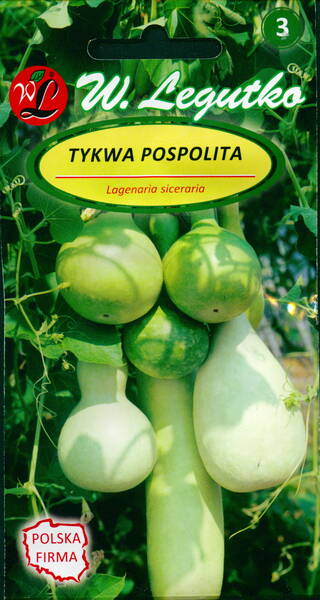

Lagenaria Mix — Lagenaria siceraria.
Lagenaria is an annual ornamental vine with shoots up to 2 meters long, belonging to the Cucurbitaceae family.
The plant is vigorous and highly branched, with soft light-green, slightly pubescent large leaves. The flowers are large, white, and resemble a huge open bell.
The fruits are pear-shaped, bottle-shaped, or elongated, almost snake-like, with a dense rind and spongy pulp.
The fruits are mainly used for decorative purposes and in floristry. Due to its spectacular appearance, lagenaria is widely used for vertical gardening.
Seeds are sown for seedlings in late April (pre-soaking is recommended). The optimal soil temperature for seed germination is +25…+30°C.
Young plants are planted outdoors in June, after the risk of frost has passed.
Lagenaria is an annual ornamental vine with shoots up to 2 meters long, belonging to the Cucurbitaceae family.
The plant is vigorous and highly branched, with soft light-green, slightly pubescent large leaves. The flowers are large, white, and resemble a huge open bell.
The fruits are pear-shaped, bottle-shaped, or elongated, almost snake-like, with a dense rind and spongy pulp.
The fruits are mainly used for decorative purposes and in floristry. Due to its spectacular appearance, lagenaria is widely used for vertical gardening.
Seeds are sown for seedlings in late April (pre-soaking is recommended). The optimal soil temperature for seed germination is +25…+30°C.
Young plants are planted outdoors in June, after the risk of frost has passed.
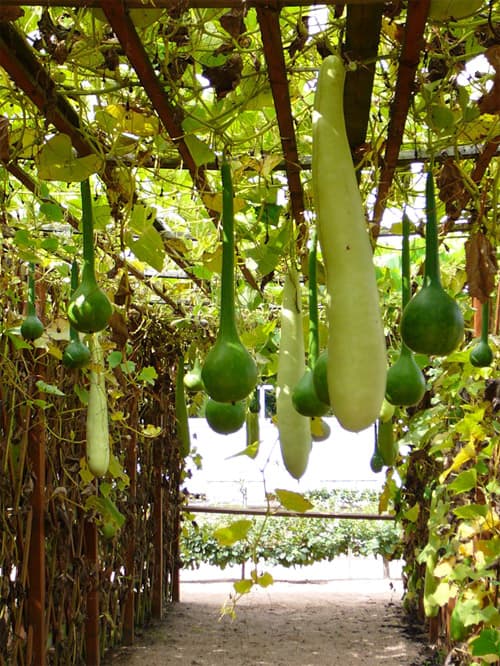
Lagenaria is an annual plant of the Cucurbitaceae family, intended for outdoor cultivation.
The fruits are white, light green, or green (turning yellow when ripe), often patterned, and vary in shape — bottle-shaped, pear-shaped, cylindrical, spherical, and others.
Cylindrical fruits can reach an impressive length of 1.5–2 meters and weigh 3–7 kg.
Young fruits 40–50 cm long are commonly eaten.
For cooking, you can cut off only the required part of a growing fruit. The remaining part continues to grow, and the cut surface quickly hardens and forms a new skin.
Bottle-type lagenaria fruits have tasteless pulp and are not eaten. Fully mature hardened fruits are used for decorative purposes. The optimal soil temperature for germination is +25…+30°C.
Bot. syn.: Cucumis bicirrha Forster ex Guillemin, Cucumis lagenarius, Cucumis mairei H.Lev., Cucurbita lagenaria L., Cucurbita leucantha Duchesne, Cucurbita longa hort., Cucurbita siceraria Molina, Lagenaria leucantha Rusby, Lagenaria vulgaris Ser.
* Lagenaria — Lagenaria siceraria.
This plant belongs to the gourd family. At an early stage, its fruits resemble elongated greenhouse cucumbers in shape and zucchinis in color. They are edible only when immature, at a diameter of 2–3 cm and a length of 30–50 cm. Remarkably, the fruit continues to grow quickly if only the necessary part is cut off — the cut surface does not rot and heals rapidly!
During the growing season, 3–4 feedings are carried out using a garden fertilizer: 20 g per 5 liters of water or 150–200 g of wood ash per 5 liters of water for two plants.
Lagenaria vines reach 10–15 meters in length, so they are guided along fences or allowed to climb nearby trees.
The flowers are large and white, opening in the afternoon and fully opening late in the evening. At this time, pollinating insects are inactive, so the plant is pollinated manually using pollen from 2–3 male flowers. Fruits reaching 50–60 cm are suspended; otherwise, they grow curved. Only one fruit is left for seed production every 4–5 years.
In autumn, before frost, the fruit is cut with the stem and stored at room temperature until the end of November. By this time, the seeds fully mature and are then extracted. Seed viability is preserved for up to 8 years.
In the plant’s native regions, the hardened rind of mature fruits is used to store liquids and dry foods. Milk stored in such containers does not spoil for a long time, as the vessel does not allow heat penetration and is resistant to microorganisms, which is especially important in hot climates.
Additionally, the rind is used to create decorative items such as vases, bowls, and other crafts. If, at an early growth stage, the fruit is placed into a detachable mold of any shape (for example, a jug or bottle), it will completely fill it. The internal volume of the mold must correspond to the final size of the mature fruit.
That’s how fascinating and versatile the lagenaria plant is!